Introduction
Learning how to stop a dog from barking at other dogs on leash can make everyday walks calmer and more enjoyable. A dog that barks, lunges, freezes, or pulls whenever another dog appears is not necessarily aggressive. Leash reactivity can come from fear, frustration, excitement, poor social experiences, or simply being unable to move freely.
The most effective approach is not to punish the barking. Instead, you need to understand what triggers your dog, prevent repeated explosive reactions, and teach a calmer response. The American Veterinary Society of Animal Behavior recommends reward-based training and advises against aversive methods such as leash corrections, physical punishment, and intimidation.
This guide explains a practical reactivity protocol you can use during walks. It focuses on distance, timing, desensitization, counter-conditioning, and teaching your dog what to do when another dog appears.
Why Does a Dog Bark at Other Dogs on Leash?
Before learning how to stop a dog from barking at other dogs on leash, identify what is driving the behavior. Barking is communication, and the same outward behavior can have different causes.
Fear and Anxiety
A nervous dog may bark because another dog feels threatening. The leash can make the situation harder because the dog cannot simply walk away.
In this situation, barking may function as a distance-increasing behavior. Your dog is essentially communicating that they want the other dog farther away.


Frustrated Greeting
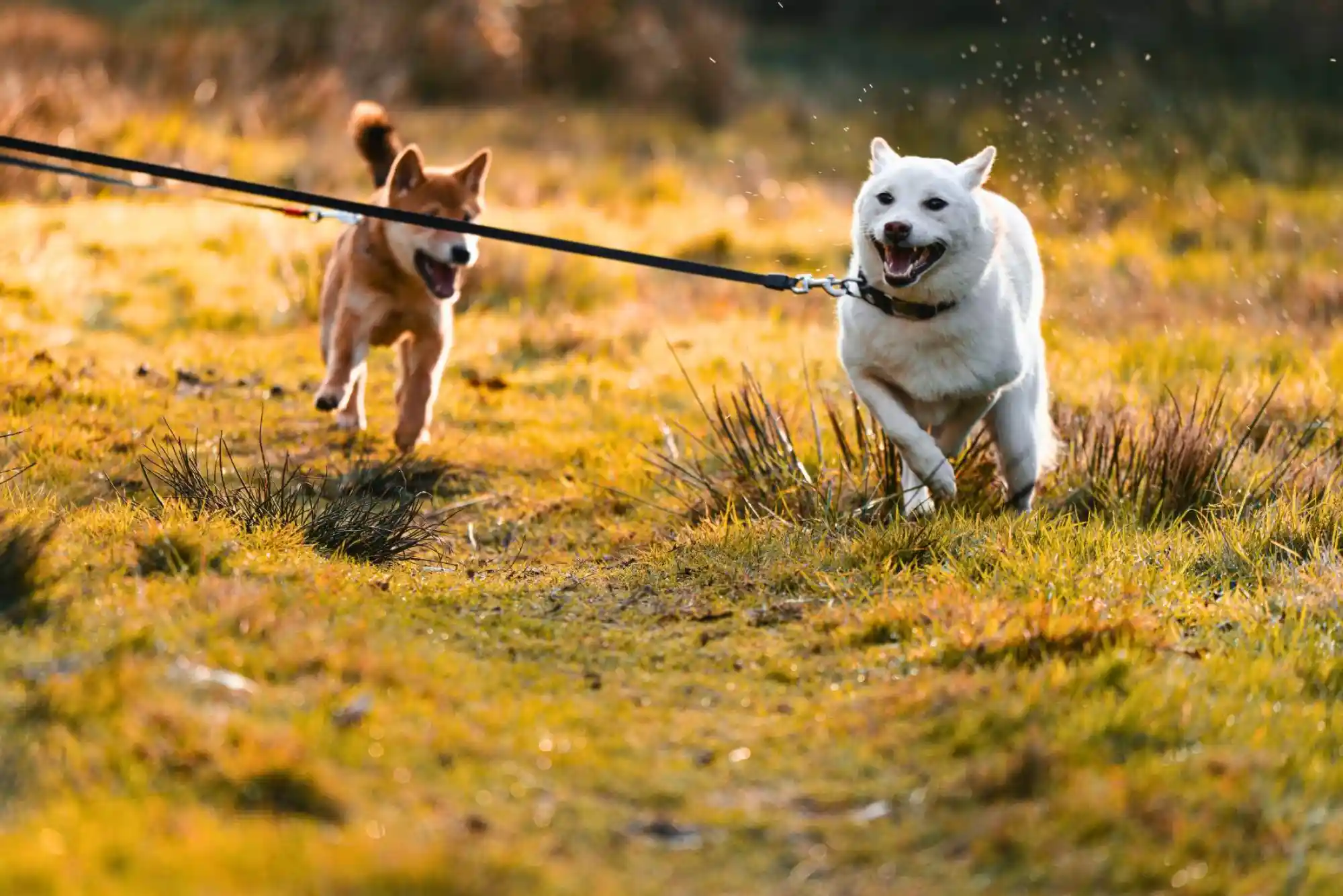
Some dogs bark because they desperately want to approach the other dog. They may wag their tail, pull forward, whine, jump, and bark.
The American Kennel Club notes that some dogs are friendly off leash but become reactive when restraint prevents them from greeting another dog.
This is often called leash frustration or frustrated greeting.
Overexcitement
Some dogs become so stimulated by movement, smells, and other animals that they lose their ability to make calm decisions.
The problem is not necessarily that the dog dislikes other dogs. Their arousal level is simply too high.
Previous Negative Experiences
A frightening encounter can change how a dog responds to similar situations later. A dog that was attacked, repeatedly rushed by unfamiliar dogs, or overwhelmed during social interactions may begin reacting defensively.
Understanding the reason matters because the goal is to change the dog’s emotional response, not simply suppress the noise.
What Is Leash Reactivity?
Leash reactivity describes an exaggerated response to a trigger while a dog is restrained. Barking, lunging, growling, spinning, staring, whining, and pulling can all occur.
Importantly, reactivity does not automatically mean aggression. A reactive dog may be frightened, frustrated, excited, or conflicted without intending to harm another dog.
That distinction is important when developing a training plan.
If your dog is already barking and lunging intensely, repeatedly forcing close encounters can make the problem harder. Instead, work at a distance where your dog can notice another dog while remaining capable of thinking and responding to you.
The Core Principle: Work Below Your Dog’s Threshold
The most important part of learning how to stop a dog from barking at other dogs on leash is understanding the threshold.
Your dog’s threshold is the point where seeing another dog causes their emotional response to become too intense for normal learning.
For example, imagine your dog can calmly look at another dog from 100 feet away. At 60 feet, they become tense. At 30 feet, they bark and lunge.
The useful training zone is somewhere around 100 to 60 feet, not 30 feet.
Distance is therefore one of your most powerful training tools.
If your dog starts barking, do not think, “Now I need to make them obey.” Think, “We are too close.”
Calmly create more space by crossing the street, turning around, moving behind a parked car, or stepping onto a driveway or open area.
Step-by-Step Reactivity Protocol
Step 1: Find Your Dog’s Starting Distance
Choose an area where you can see other dogs without being forced into close encounters.
When your dog notices another dog, watch their body language.
If your dog can look at the other dog and then look back at you, eat treats normally, or respond to their name, you may be at a workable distance.
If your dog is staring intensely, refusing food, barking, lunging, or completely ignoring you, increase the distance.
This first step is often where owners make the biggest mistake. They begin too close because they want their dog to “get used to” other dogs.
Desensitization works gradually. Flooding a dog with an overwhelming trigger is not the same thing as controlled exposure, and AVSAB specifically advises against flooding and other aversive approaches.
Step 2: Pair Other Dogs With Something Valuable
Once you have found a workable distance, begin changing what another dog means to your dog.
The instant your dog notices another dog, calmly mark the moment with a word such as “yes” and give a high-value treat.
Chicken, cooked meat, cheese, or another food your dog genuinely loves can work well.
The sequence should look like this:
Your dog sees another dog → marker → treat.
After several repetitions, your dog begins learning that another dog appearing predicts something positive.
You are not rewarding the barking. You are reinforcing calm observation before the reaction occurs.
Step 3: Reward Looking Away
Eventually, you want your dog to notice another dog and then voluntarily disengage.
This is a major milestone.
Your dog looks at the other dog.
Then they glance back toward you.
Mark and reward that choice.
You can gradually build a behavior pattern where your dog sees a trigger, checks in with you, and continues walking.
This is more useful than simply teaching a “quiet” command because it gives your dog an alternative behavior.
Step 4: Teach an Emergency U-Turn
Real walks are unpredictable. Another dog may suddenly appear around a corner or exit a house.
Teach your dog an emergency turn before you need it.
At home or in a quiet location, say a cheerful cue such as “this way,” turn around, and reward your dog for following.
Practice until turning with you becomes automatic.
Then use the cue when another dog appears too close.
The goal is not to escape every dog forever. It is to prevent unnecessary explosions while your training progresses. The AKC also recommends proactive avoidance skills, including emergency turns and other cues, for dogs that struggle with approaching dogs.
Step 5: Gradually Reduce Distance
Once your dog can consistently remain calm at the starting distance, you can experiment with getting slightly closer.
Do not make dramatic changes.
Move closer only when your dog is comfortable and continue rewarding calm behavior.
If your dog suddenly starts barking, you have probably progressed too quickly. Increase distance again and return to an easier level.
There is no prize for getting close to another dog quickly.
Successful behavior modification is about creating many calm repetitions.
What Should You Do When Your Dog Starts Barking?
Knowing what to do during an unexpected reaction is an essential part of how to stop a dog from barking at other dogs on leash.
First, avoid jerking the leash or yelling.
Instead, create distance.
Turn and walk away if necessary. Put a physical barrier between the dogs if one is available. Keep your movements controlled and avoid dragging your dog toward the trigger.
Once your dog can think again, reward calm behavior.
The goal during an unexpected reaction is management, not a perfect training session.
You do not need to “win” the encounter.
You simply need to prevent the reaction from escalating and give your dog an opportunity to recover.
Avoid Punishing Leash Reactivity
It can be frustrating when your dog barks at every dog on the sidewalk. However, punishment can create additional problems, particularly when fear or anxiety is involved.
AVSAB recommends reward-based training for canine behavior modification and advises against methods involving physical force, leash jerking, intimidation, shock collars, prong collars, and other aversive techniques.
Punishing a frightened dog may suppress visible behavior without addressing the underlying emotion.
For example, a dog may stop barking because they are worried about what will happen if they bark. That does not necessarily mean they are now comfortable around other dogs.
Instead, focus on changing the emotional association and teaching a practical alternative behavior.
How Long Does Leash Reactivity Training Take?
There is no universal timeline.
Some dogs show noticeable improvement after consistent practice, while others need months of carefully managed training. Factors include the dog’s history, temperament, trigger distance, intensity of reactions, environment, and how consistently the plan is followed.
Avoid judging progress by whether your dog never barks again.
Instead, look for smaller improvements.
Your dog may recover faster after seeing another dog. They may be able to work at a shorter distance. They may look at you sooner. Their barking may become shorter or less intense.
Those changes matter.
Progress in behavior modification is often gradual rather than perfectly linear.
Common Mistakes That Slow Progress
Getting Too Close Too Quickly
Walking directly toward unfamiliar dogs to “socialize” a reactive dog can create repeated failures.
Give your dog enough space to succeed.
Waiting Until the Barking Starts
Training is much easier before your dog reaches full arousal.
Watch for early signs such as staring, stiffening, closed mouth, slowing down, pulling, or becoming fixated.
Using Low-Value Rewards
If ordinary kibble cannot compete with an exciting dog nearby, use something more valuable during training.
Save special treats for situations that genuinely require them.
Expecting Perfect Behavior on Every Walk
A busy sidewalk is not always the best training environment.
Some walks should simply be decompression walks where you avoid difficult encounters and allow your dog to sniff and move comfortably.
When Should You Get Professional Help?
Professional assistance is particularly important when a dog has attempted to bite, has caused injury, cannot safely be handled on walks, or reacts so intensely that ordinary training is impossible.
A veterinarian can also help rule out medical factors that may contribute to behavior changes.
For serious aggression or complex behavior problems, consider working with a qualified veterinary behavior professional or an experienced reward-based behavior consultant. AVSAB recommends seeking qualified professional help when behavior modification is difficult or when aggression is involved.
Choose a professional carefully. Ask what methods they use and whether they rely on rewards, management, and gradual behavior modification.
Build Calm Responses One Walk at a Time
Learning how to stop a dog from barking at other dogs on leash is less about forcing silence and more about changing the way your dog responds to the trigger.
Start with distance. Learn your dog’s threshold. Reward calm observation. Teach an emergency turn. Gradually reduce distance only when your dog is ready, and avoid situations that repeatedly push them into an explosive reaction.
Most importantly, remember that reactivity is behavior with an underlying emotional component. Your dog needs a clear alternative, not simply punishment for reacting.
FAQs
How do I stop my dog from barking and lunging at other dogs on walks?
Start by increasing the distance between your dog and other dogs. Work at a distance where your dog can notice another dog without barking or lunging. Reward calm observation and gradually teach your dog to disengage and focus on you. If your dog reacts, create more distance rather than correcting them physically.
Why does my dog bark at other dogs when on a leash but not off leash?
The leash restricts your dog’s ability to approach, retreat, or move freely. Some dogs become frustrated because they cannot greet another dog, while others feel trapped and bark because they want more distance. Leash reactivity therefore does not automatically indicate aggression.
Should I let my dog greet other dogs on walks?
Not necessarily. Your dog does not need to greet every dog they encounter. Frequent on-leash greetings can increase excitement and may make some dogs expect access to every dog they see. Teaching your dog to calmly pass other dogs can be a more useful walking skill.
Should I punish my dog for barking at other dogs?
Reward-based training is generally recommended instead of punishment for behavior modification. Punishing barking can increase fear or stress in some dogs, particularly when the underlying problem is anxiety. AVSAB recommends reward-based methods and advises against aversive training techniques.
How far away should I be from another dog during reactivity training?
There is no universal distance. Start far enough away that your dog can notice another dog while still eating treats, responding to you, and remaining relatively calm. That distance may be 20 feet for one dog and 100 feet or more for another.
Can a leash-reactive dog be cured?
Many dogs can make substantial improvements with appropriate management and consistent behavior modification, but “cure” is not the most useful way to measure progress. The practical goal is to help your dog remain calmer, recover faster, and safely navigate situations involving other dogs.