
Introduction
Large dogs need equipment that can handle their size, strength, and energy without restricting natural movement. For working breeds, service dogs, hiking companions, and dogs that need closer handling, a standard walking harness may not provide enough control. This is where tactical dog harnesses with handle can be useful.
A well-designed tactical harness combines a secure fit with a practical control handle, durable webbing, leash attachment points, and, in many models, MOLLE panels or hook-and-loop areas. However, “tactical” does not automatically mean stronger or safer. Construction, sizing, stitching, hardware, and the intended use matter much more than appearance.
For large breeds such as German Shepherds, Rottweilers, Belgian Malinois, Dobermans, and other powerful dogs, choosing the right harness starts with understanding what the dog actually needs. A harness designed for everyday walking is not necessarily suitable for working tasks, while a heavily equipped tactical vest may be unnecessary for a calm companion.
What Makes Tactical Dog Harnesses With Handle Different?
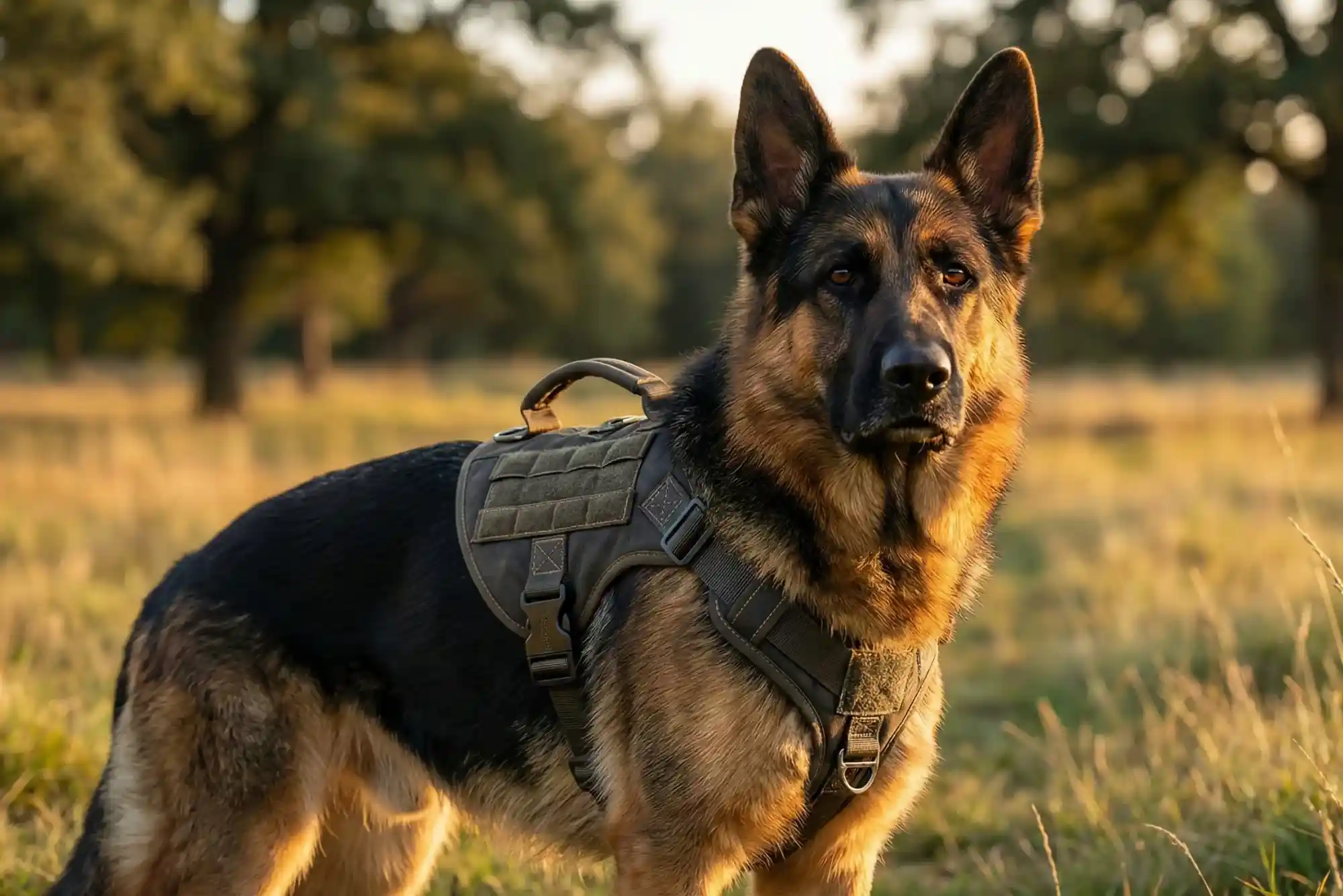
The defining feature is usually the combination of a structured harness and a built-in handle. The handle gives the handler a quick point of contact when a dog needs to be steadied, redirected, or kept close.
Some handles are designed primarily for short-duration control. Others are marketed for assistance or lifting, but owners should never assume that a handle is safe for supporting a dog’s entire body weight unless the manufacturer specifically provides an appropriate rating.
Current harness comparisons show considerable variation in construction. Some models use 1000D-style nylon, reinforced stitching, metal hardware, MOLLE webbing, and multiple leash attachment points, while others are lighter and intended mainly for recreational walking.


The difference becomes particularly important with large dogs. A powerful dog can place substantial force on buckles, seams, and attachment points. A harness that looks rugged in photographs may still have limitations that are not obvious from its appearance.
Why Large Breeds Benefit From a Handle
Large dogs can be difficult to control quickly, especially in crowded environments, training sessions, or unfamiliar locations. A properly positioned handle allows the handler to shorten the distance between their hand and the dog’s body without grabbing at the collar.
For example, a handler may need to guide a dog through a doorway, move around another animal, or stabilize the dog while adjusting equipment. In those situations, a top-mounted handle can be more convenient than reaching for the leash.
The handle also has practical value during outdoor activities. Hiking dogs may need assistance over a small obstacle or rough section of terrain. However, assistance should not be confused with lifting. Unless the manufacturer specifically designs and rates the harness for lifting, the handle should be treated as a control point rather than a carrying handle.
The Ruffwear Web Master, for example, uses a padded lift handle and a three-point structure, with published girth sizing extending from 13 to 42 inches. Its design illustrates why the handle and overall harness structure need to be considered together.
Features to Look for in Tactical Dog Harnesses With Handle
A Properly Positioned Control Handle
The handle should be easy to reach without interfering with the dog’s movement. It should also be securely attached to the harness structure rather than simply sewn onto a thin decorative panel.
For powerful dogs, examine the stitching around the handle. Reinforced or bar-tacked stitching can provide additional durability, although the presence of reinforcement alone does not establish a specific load capacity.
If a manufacturer does not publish a handle load rating, avoid treating the handle as lifting equipment. This distinction is especially important for mobility or assistance work.
Multiple Adjustment Points
Large breeds do not all have the same body shape. A German Shepherd, Great Dane, Rottweiler, and Labrador Retriever can have very different chest and shoulder proportions despite having similar body weights.
A harness with several adjustment points can provide a more precise fit. The dog should have enough freedom around the shoulders while the harness remains secure around the chest.
The harness should not slide excessively from side to side, ride into the throat, or rub behind the front legs.
Strong Leash Attachment Points
A tactical harness can have one or several leash attachment points. Back attachments are commonly used for everyday walking, while front attachments can provide additional control during training.
Some working-oriented harnesses provide front and rear attachment points, giving handlers more flexibility depending on the activity. Current 2026 comparisons show this feature across several tactical harness designs.
The attachment hardware should be inspected regularly. Even a strong metal ring cannot compensate for poor stitching or a harness that does not fit correctly.
Durable Webbing and Reinforced Construction
Tactical harnesses often use heavier webbing and nylon than lightweight pet harnesses. Materials such as 1000D nylon are common in tactical-style products, although material thickness alone does not determine overall durability.
Pay attention to stress points around the handle, leash rings, buckles, and adjustment areas. Those locations experience more force than the middle of the vest.
A professional-looking MOLLE panel is also not necessarily evidence of superior construction. Some consumer harnesses use MOLLE-style webbing primarily for appearance or lightweight accessory attachment.
Tactical Harnesses for Service Dogs
Service dogs have specific working requirements, and the harness should support those tasks rather than simply advertise that the dog is a service animal.
A service dog may benefit from a handle for close control, but the exact design depends on the dog’s trained tasks. Some handlers may need a simple control handle, while others may require a specialized mobility-assistance harness.
It is also important to separate identification from function. A patch that says “Service Dog” does not itself give a dog public-access rights. In the United States, federal ADA rules do not require service dogs to wear a particular harness, vest, or identification item.
For that reason, choose the harness based on fit and working requirements first. Identification patches can be added when appropriate.
How to Choose the Right Size for a Large Dog
Sizing is one of the most important parts of buying tactical dog harnesses with handle. Do not select a size based only on your dog’s weight or breed.
Measure the Chest Girth
Use a flexible measuring tape around the widest part of the dog’s rib cage, generally just behind the front legs. Keep the tape snug without compressing the coat or body.
Compare that measurement with the manufacturer’s size chart.
Current harness specifications demonstrate why this matters. The Ruffwear Web Master, for example, covers a broad 13-to-42-inch girth range across its sizes, while several professional-style harnesses have narrower size windows.
Check the Fit After Adjustment
Once the harness is on, check the shoulder area, chest, neck, and belly straps. You should be able to place approximately two fingers beneath appropriately adjusted straps, while avoiding excessive looseness.
The harness should remain stable when the dog walks, turns, sits, and moves its front legs.
A harness that shifts dramatically during movement may create rubbing and reduce control. An overly tight harness can restrict movement and create pressure points.
Best Uses for Tactical Dog Harnesses With Handle
Tactical harnesses can be useful for several different activities, but not every model is suitable for every job.
For everyday walking, a lightweight tactical-style harness with a comfortable handle may provide convenient close control. For hiking, durability and breathable padding become more important because the dog may wear the harness for extended periods.
Working and training dogs may benefit from multiple leash points, stronger hardware, and modular attachment areas. Search-and-rescue handlers may have different requirements again, particularly if equipment must be attached to the harness.
Some current working-dog harnesses are specifically designed around MOLLE compatibility, multiple attachment points, and reinforced control handles.
The important point is to match the harness to the activity rather than buying the most heavily equipped vest available.
Comfort Matters as Much as Durability
A strong harness that causes constant rubbing is not a good working solution.
Look for padding around areas where the harness contacts the chest and shoulders. Breathable materials can also make a significant difference in warm climates.
Large dogs can generate considerable body heat, particularly during exercise. Heavy tactical materials and extensive MOLLE panels can increase overall weight and reduce ventilation.
This is why a harness designed for patrol or equipment carrying may not be ideal for casual summer walks.
Check the dog’s skin after initial use, especially behind the front legs and around the chest. Redness, hair loss, or repeated scratching can indicate a fit or material problem.
Common Mistakes When Buying a Tactical Harness
One common mistake is choosing a harness because it looks military-grade. Camouflage fabric, MOLLE panels, and thick nylon can make a product appear extremely durable, but those features do not automatically prove that it is suitable for heavy working use.
Another mistake is relying on weight alone when choosing a size. Chest girth and body shape usually provide more useful information.
Some owners also assume that every handle is designed for lifting. That can be dangerous. Unless the manufacturer explicitly states that the harness supports lifting or mobility assistance, use the handle for control and brief guidance.
Finally, avoid leaving a tactical harness fitted incorrectly simply because the dog appears comfortable. A loose harness can shift during movement, while an excessively tight one can create pressure and rubbing.
How to Maintain a Tactical Dog Harness
Regular inspection can extend the useful life of tactical dog harnesses with handle.
Check the handle stitching, leash rings, buckles, adjustment points, and webbing before demanding activities. Look for fraying, stretched stitching, cracked hardware, or damaged buckles.
Clean the harness according to the manufacturer’s instructions. Dirt and sand can collect around buckles and adjustment areas, while moisture can contribute to odor and material deterioration.
If the harness has MOLLE panels or hook-and-loop sections, inspect those areas as well. Accessories can add weight and change how the harness sits on the dog.
For a working dog, it is sensible to inspect the harness more frequently than you would for occasional walking.
Tactical Dog Harnesses With Handle vs. Standard Harnesses
A standard harness is often enough for everyday walking, particularly when the dog walks calmly and does not require close physical control.
Tactical dog harnesses with handle become more useful when the handler needs a convenient grip, additional attachment points, modular storage, or more rugged construction.
However, more features are not always better. A bulky vest can be unnecessary for a dog that simply needs a comfortable walking harness.
Think about the dog’s routine first. If the dog spends most of the day walking around the neighborhood, prioritize comfort and fit. If the dog participates in hiking, training, service work, or other demanding activities, durability and specialized features may become more important.
FAQs
Are tactical dog harnesses good for large dogs?
Yes, they can be useful for large dogs when the harness is correctly sized and appropriate for the dog’s activity. Large breeds can benefit from reinforced construction, secure adjustment points, and a convenient control handle. However, the label “tactical” does not guarantee that a harness is suitable for heavy pulling or lifting.
What is the best handle for a large dog harness?
The most useful handle is one that is securely integrated into the harness and positioned where the handler can comfortably reach it. For powerful dogs, examine how the handle is attached and whether the manufacturer provides a specific load rating. If no lifting rating is published, use the handle for short-term control rather than supporting the dog’s full weight.
Can you lift a dog with a tactical harness handle?
Not necessarily. A handle should only be used for lifting when the manufacturer explicitly designs and rates the harness for that purpose. A standard control handle may be intended only for restraint, steering, or brief assistance.
What size harness does a 100-pound dog need?
There is no universal harness size for a 100-pound dog. Body shape and chest girth vary significantly between breeds. Measure the dog’s chest and compare it with the manufacturer’s sizing chart rather than choosing a size based solely on body weight.
Are tactical harnesses good for service dogs?
They can be, provided the harness supports the dog’s trained tasks and fits comfortably. A service dog does not automatically need a tactical-style vest. Some service-dog handlers prefer a simple harness, while others may need a specialized handle or assistance design.
Does a service dog legally need a harness?
In the United States, federal ADA rules do not require service dogs to wear a particular harness, vest, or identifying equipment. A harness can still be useful for handling and communication, but the equipment itself does not establish service-dog status.
Choosing among tactical dog harnesses with handle is less about finding the most rugged-looking vest and more about matching the equipment to your dog’s size, body shape, temperament, and daily work.
For large breeds, focus on accurate girth measurement, secure adjustment, reinforced handle construction, reliable leash attachment points, and comfortable shoulder movement. For service dogs, consider the specific task requirements rather than choosing a vest simply because it carries service-dog patches.
A tactical harness can provide excellent control and versatility when it is properly fitted and used for its intended purpose. Before buying, measure your dog carefully, review the manufacturer’s specifications, and inspect the harness regularly after use.