
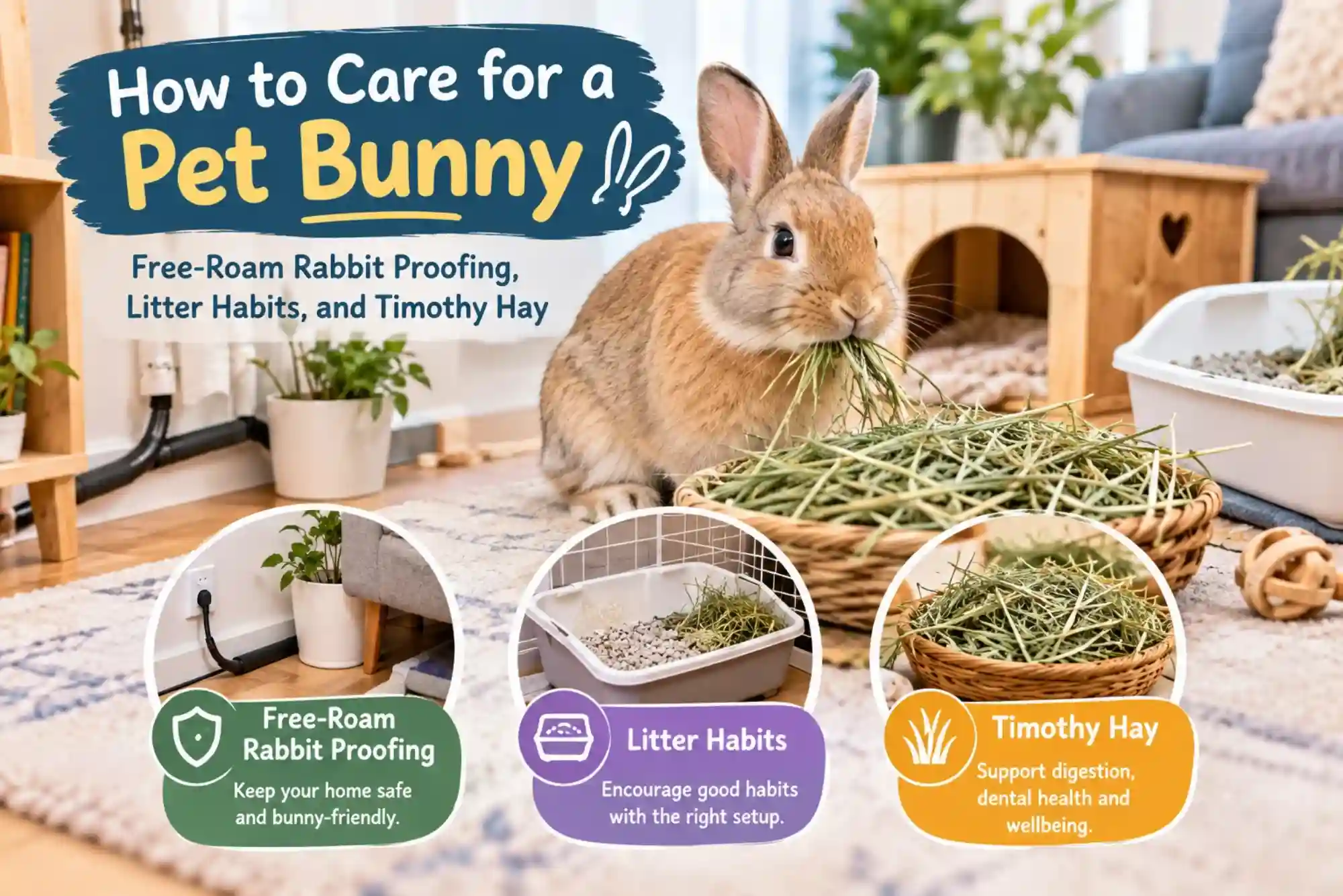
Timothy hay is especially important for many adult rabbits because grass hay provides the fiber needed for healthy digestion and supports normal tooth wear. At the same time, a free-roaming rabbit can quickly discover electrical cables, furniture, houseplants, carpets, and other household objects that may be unsafe or tempting to chew. Proper preparation can make the home much safer while still allowing the rabbit to explore.
This guide explains how to care for a pet bunny, how to prepare a rabbit-friendly home, how to encourage good litter habits, and how to make Timothy hay an important part of your rabbit’s everyday routine.
Understanding the Needs of a Pet Bunny
Before allowing a rabbit to roam freely, it is important to understand that rabbits have natural behaviors that influence almost every part of their care. They like to explore, chew, dig, forage, hide, rest, and investigate new objects. Chewing is not simply bad behavior; it is a normal rabbit activity that needs to be redirected toward safe alternatives.
Rabbits are also social and intelligent animals. They benefit from interaction, enrichment, exercise, and an environment where they can behave naturally. A small cage alone is not an adequate long-term lifestyle for a companion rabbit. Rabbit welfare organizations recommend spacious indoor housing and opportunities for exercise and exploration.
A good setup can begin with a secure pen or designated rabbit area. Once the rabbit has become comfortable and has developed reliable litter habits, access to additional parts of the home can be gradually increased.
[Internal Link 1: Complete Pet Rabbit Care Guide]


The goal is not simply to give a rabbit more space. The goal is to create a space where the rabbit can explore safely while the owner can maintain a practical daily routine.
Preparing Your Home for Free-Roam Rabbit Time
Free-roaming can give a rabbit more opportunities to exercise and interact with its surroundings, but the home must be prepared first. Rabbits can chew surprisingly quickly, so owners should never assume that an object is safe simply because the rabbit has ignored it in the past.
Electrical cables deserve particular attention. Rabbits may chew wires, and an exposed electrical cable can create a serious hazard. Rabbit-care guidance recommends covering accessible wires with protective tubing or blocking the rabbit’s access to them.
Look around the room from the rabbit’s perspective. Cables behind desks, chargers beside beds, television wires, computer equipment, floor lamps, and extension cords may all need protection.
Furniture should also be considered. Some rabbits enjoy chewing wooden furniture, table legs, baseboards, and carpet edges. Instead of relying on training alone, physically block areas that are difficult to protect.
A rabbit should also be kept away from potentially toxic houseplants. If you are not completely certain that a plant is safe for rabbits, the simplest approach is to keep it outside the rabbit’s accessible area.
Protecting Floors, Carpets, and Furniture
Rabbits need surfaces that provide secure traction. Very slippery floors can make movement more difficult, particularly when a rabbit is running or changing direction.
Washable rugs or mats can create comfortable areas for movement and rest. However, owners should observe whether their rabbit chews or eats carpet fibers. If the rabbit begins pulling apart a rug, replace it with a safer alternative or restrict access.
Furniture can be protected with barriers, washable covers, or rearrangement. Corners and areas underneath furniture can be especially attractive to rabbits because they resemble hiding spaces.
A useful approach is to create approved exploration zones. Rather than trying to make every part of the house accessible immediately, start with one or two carefully prepared rooms. When the rabbit demonstrates consistent behavior and reliable litter habits, the accessible area can gradually expand.
Rabbit.org also recommends providing safe enrichment such as cardboard boxes and appropriate chewable materials so rabbits have acceptable alternatives to household objects.
Creating a Safe Rabbit Home Base
Even a rabbit that eventually enjoys free-roaming should have a dedicated home base. This can be an exercise pen or another secure area containing essential resources.
The home base should include fresh water, food, hay, a litter box, resting space, hiding opportunities, and appropriate enrichment. It should be large enough for the rabbit to stretch, turn around, and move comfortably.
A home base is particularly useful during the early stages of litter training. Instead of giving a new rabbit unrestricted access to the entire home, begin with a smaller safe area. This allows the rabbit to learn where the litter box is located.
Once the rabbit consistently uses the litter box, the area can be expanded.
This gradual process is often more successful than giving a new rabbit complete freedom immediately.
How to Start Litter Training a Rabbit
One of the most useful characteristics of rabbits is that many can develop good litter habits. Rabbits naturally tend to choose specific places for urination and frequently use preferred areas for droppings.
Start by observing where your rabbit chooses to go. If the rabbit repeatedly selects one corner, place the litter box there. Rabbit.org recommends placing the litter box in the rabbit’s preferred bathroom location and adding hay to encourage its use.
The litter box should be large enough for the rabbit to comfortably enter, turn around, and sit inside. A box that is too small can discourage consistent use.
Place fresh hay near or inside one end of the litter box. Many rabbits naturally like to eat while using the bathroom, making the combination of hay and litter box particularly practical.
You can also place a small amount of previously soiled litter or droppings into the box. This can help communicate that the box is the appropriate bathroom location.
Choosing Safe Rabbit Litter
Choosing the correct litter is just as important as choosing the right litter box.
Rabbit-care organizations commonly recommend paper-based or other appropriate non-clumping litter materials. RSPCA guidance includes newspaper, hay, straw, shredded paper, and suitable paper-based non-clumping, non-expanding litter.
Avoid using unsuitable litter products simply because they are designed for other pets. Clay-based cat litter and certain dusty or aromatic wood products may create health concerns for rabbits. Rabbit.org specifically advises against clay litter and pine or cedar shavings.
The litter box should also be cleaned regularly. A clean box encourages good habits and helps prevent unpleasant odors.
What to Do When a Rabbit Has Accidents
Accidents are normal during the training process. Young rabbits, newly adopted rabbits, rabbits experiencing environmental changes, and unaltered rabbits may have more difficulty with consistent litter habits.
Do not punish a rabbit for an accident. Rabbits do not learn well through fear or punishment, and stressful interactions can damage trust.
Instead, clean the area thoroughly and make the preferred litter box easier to access. If the rabbit repeatedly urinates in one particular location, consider temporarily placing another litter box there.
As litter habits improve, the rabbit’s accessible area can gradually increase.
If a rabbit that was previously well litter-trained suddenly begins urinating outside the box, do not automatically assume it is a behavioral issue. Stress, environmental changes, or medical problems can sometimes affect litter habits. Rabbit.org notes that sudden changes may warrant assessment by a rabbit-savvy veterinarian, especially when other symptoms are present.
[Internal Link 2: Rabbit Litter Training and Home Care]
Timothy Hay: A Foundation of Rabbit Nutrition
Hay is one of the most important foods in a rabbit’s diet. Grass hay provides substantial fiber, supports digestion, and contributes to normal tooth wear because rabbit teeth continually grow.
Rabbit.org describes hay as a central part of the rabbit diet and recommends unlimited grass hay for adult rabbits. Its dietary guidance lists Timothy among appropriate grass hays.
RSPCA guidance similarly states that most of a rabbit’s diet should consist of fresh hay and grass, alongside appropriate leafy greens and limited pellets.
Timothy hay is popular because it is a grass hay that can form a practical everyday option for many adult rabbits.
Rather than giving hay only once a day, provide it continuously so the rabbit can graze throughout the day.
How Much Timothy Hay Should a Rabbit Eat?
For an adult rabbit, hay should make up the majority of the diet. Exact dietary proportions can vary according to the rabbit’s age, health, body condition, and veterinary recommendations, so a rabbit-savvy veterinarian should be consulted for individual dietary concerns.
The important principle is that fresh grass hay should be available regularly and should not be treated as an occasional snack.
Rabbit.org dietary resources describe hay as making up the majority of an adult rabbit’s diet and emphasize unlimited access to fresh hay.
Young rabbits and rabbits with particular health needs may have different nutritional requirements. Therefore, owners should not apply an adult feeding plan automatically to every rabbit.
How to Choose Good Timothy Hay
Good Timothy hay should generally smell fresh and grassy rather than musty. It should be reasonably dry, clean, and free from obvious mold or contamination.
Rabbits can have individual preferences. Some prefer softer hay, while others enjoy coarser stalks. If your rabbit refuses one type, that does not necessarily mean it dislikes hay altogether.
Try offering a different texture or cut of grass hay. Other grass hays can also provide useful variety.
RSPCA guidance recommends good-quality hay that is fresh, sweet-smelling, and dust-free, and explains that hay provides fiber, supports dental wear, and contributes to healthy digestion.
Store hay in a dry, well-ventilated place. Avoid storing it somewhere damp because moisture can encourage spoilage.
Making Hay More Interesting for Your Rabbit
Some rabbits eat hay readily, while others need encouragement.
One simple technique is to place hay close to the litter box. Because many rabbits like to eat while using the toilet, this can encourage both hay consumption and litter-box use.
You can also place hay in a rack or basket, provided the setup is safe and easily accessible.
Foraging activities can make feeding more engaging. Safe cardboard tubes or boxes can be used to create simple enrichment opportunities, provided the rabbit does not ingest large amounts of inappropriate material.
RSPCA enrichment guidance recommends using hay and safe materials to encourage natural chewing and foraging behavior.
The objective is not to make feeding complicated. It is to encourage natural behaviors while making fresh hay consistently available.
Timothy Hay, Pellets, Greens, and Treats
Timothy hay should not be viewed as a replacement for every other component of a rabbit’s diet. Adult rabbits generally need a balanced combination of hay, appropriate fresh greens, water, and a limited amount of suitable pellets.
Treats should remain treats rather than becoming a major part of the diet. Sweet foods can be appealing to rabbits, but excessive sugary foods are not appropriate as a dietary foundation.
RSPCA guidance recommends fresh hay and grass as the main part of the diet, with leafy greens and small amounts of pellets, while fruits and root vegetables such as carrots should be occasional treats.
Avoid making sudden dietary changes. A rabbit’s digestive system can be sensitive to abrupt changes, so new foods should be introduced carefully.
Fresh water should always be available.
Free-Roam Rabbit Care and Daily Exercise
A free-roam rabbit needs more than an open room. It needs opportunities to move, explore, hide, chew, forage, and rest.
Allowing a rabbit to explore a safe indoor area can provide physical activity and mental stimulation. Toys, cardboard structures, tunnels, and safe chew items can make the environment more interesting.
The rabbit should also have a quiet place where it can retreat when it wants to rest.
Observe your rabbit’s personality. Some rabbits immediately explore every corner, while others are cautious and prefer to investigate slowly.
Do not force a nervous rabbit to explore. Give it time and allow confidence to develop naturally.
Free-Roaming With Other Pets
Extra care is necessary when rabbits share a home with cats or dogs. Rabbits are prey animals, and even a friendly household pet can accidentally frighten or injure them.
RSPCA guidance advises that rabbits should not be left unsupervised with cats or dogs, even when the animals appear to have developed a friendship.
Use barriers, separate areas, and controlled introductions. The rabbit should always have somewhere safe to retreat.
The aim is not simply to make animals tolerate one another. The rabbit must feel secure in its environment.
Maintaining Good Free-Roam Habits
Once your rabbit has learned to use its litter box and has become familiar with the safe areas of your home, maintaining the routine becomes easier.
Keep the litter box in a consistent location whenever possible. Provide hay regularly and make sure water is available.
Continue checking electrical cables, plants, furniture, and other hazards because rabbit-proofing is not a one-time task. Rabbits grow, learn new behaviors, and sometimes discover new ways to reach objects.
A rabbit that previously ignored a cable may eventually decide to investigate it.
Regular observation is therefore an important part of free-roam care.
Cleaning and Hygiene
Good hygiene supports a comfortable indoor environment.
Remove wet litter regularly and clean the litter box thoroughly. Wash food and water containers frequently and remove spoiled food.
Hay should be replaced when it becomes damp, dirty, or contaminated.
Keep the rabbit’s living area dry and comfortable. Excess moisture, poor ventilation, and accumulated waste can create an unhealthy environment.
Cleaning should be part of the daily routine rather than something done only when the area looks dirty.
Watching for Changes in Health
Rabbits can hide signs of illness, so owners should pay attention to changes in eating, drinking, activity, droppings, and general behavior.
A rabbit that suddenly stops eating or producing normal droppings may require prompt veterinary attention. Rabbit.org’s rabbit-care resources emphasize the importance of rabbit-savvy veterinary care and identify changes such as not eating, not drinking, or not producing urine or feces as reasons for urgent attention.
Regular veterinary care is also important. If possible, identify a veterinarian experienced with rabbits before an emergency occurs.
Do not wait until your rabbit is seriously ill before finding professional care.
[Internal Link 3: Complete Rabbit Health and Nutrition Guide]
Building a Comfortable Routine
Rabbits generally benefit from predictable routines. Feeding, cleaning, exercise, and interaction at consistent times can help them feel secure.
A simple daily routine might include refreshing hay and water, checking the litter box, observing eating and bathroom habits, providing exercise and enrichment, and checking the rabbit’s environment for new hazards.
The exact schedule can vary according to the household and the rabbit’s needs.
The important part is consistency.
A well-planned routine also makes it easier for owners to notice unusual changes. When you know what your rabbit normally eats, how often it uses the litter box, and how active it usually is, changes become easier to identify.
Common Mistakes New Rabbit Owners Make
One common mistake is giving a rabbit too much freedom before the home has been properly rabbit-proofed. Free-roaming should be introduced gradually.
Another mistake is assuming that litter training means the rabbit will never have an accident. Even well-trained rabbits can have occasional accidents, particularly after environmental changes.
A third mistake is treating hay as an optional food. For adult rabbits, grass hay should be a major part of the daily diet.
Some owners also provide too many treats because rabbits appear to enjoy them. Treats should not replace the high-fiber foods that form the foundation of healthy rabbit nutrition.
Finally, relying on supervision alone is risky. A rabbit can reach a dangerous object quickly. Physical barriers and proper rabbit-proofing are more reliable than simply watching the rabbit.
Final Thoughts
Learning how to care for a pet bunny is largely about creating the right environment and maintaining consistent daily habits. Free-roam rabbit care can provide excellent opportunities for exercise and exploration, but the home must be carefully prepared before a rabbit is given unrestricted access.
Rabbit-proofing should focus particularly on electrical cables, toxic plants, unsafe furniture areas, flooring, and other objects that a curious rabbit may chew. A secure home base provides an important place for food, water, rest, enrichment, and litter training.
Litter habits can usually be encouraged by placing a suitably sized litter box in the rabbit’s preferred bathroom location and making hay readily available nearby. Patience and positive reinforcement are more useful than punishment.
Timothy hay is another essential part of everyday rabbit care. Quality grass hay provides important fiber and supports healthy digestion and normal tooth wear. It should be readily available, fresh, clean, and stored properly.
When these three areas—safe free-roaming, reliable litter habits, and consistent hay access—are combined with appropriate veterinary care, enrichment, fresh water, and a balanced diet, owners can create a healthier and more comfortable home for their rabbit.
The best rabbit-care routine is not necessarily complicated. It is consistent, safe, and designed around the natural needs of the animal. With proper preparation, a pet bunny can enjoy an enriched indoor life while becoming a trusted and entertaining member of the household.
Related Reading: Feline Diabetes Symptoms, Insulin Care, and Low-Carb Wet Food Meal Plans