
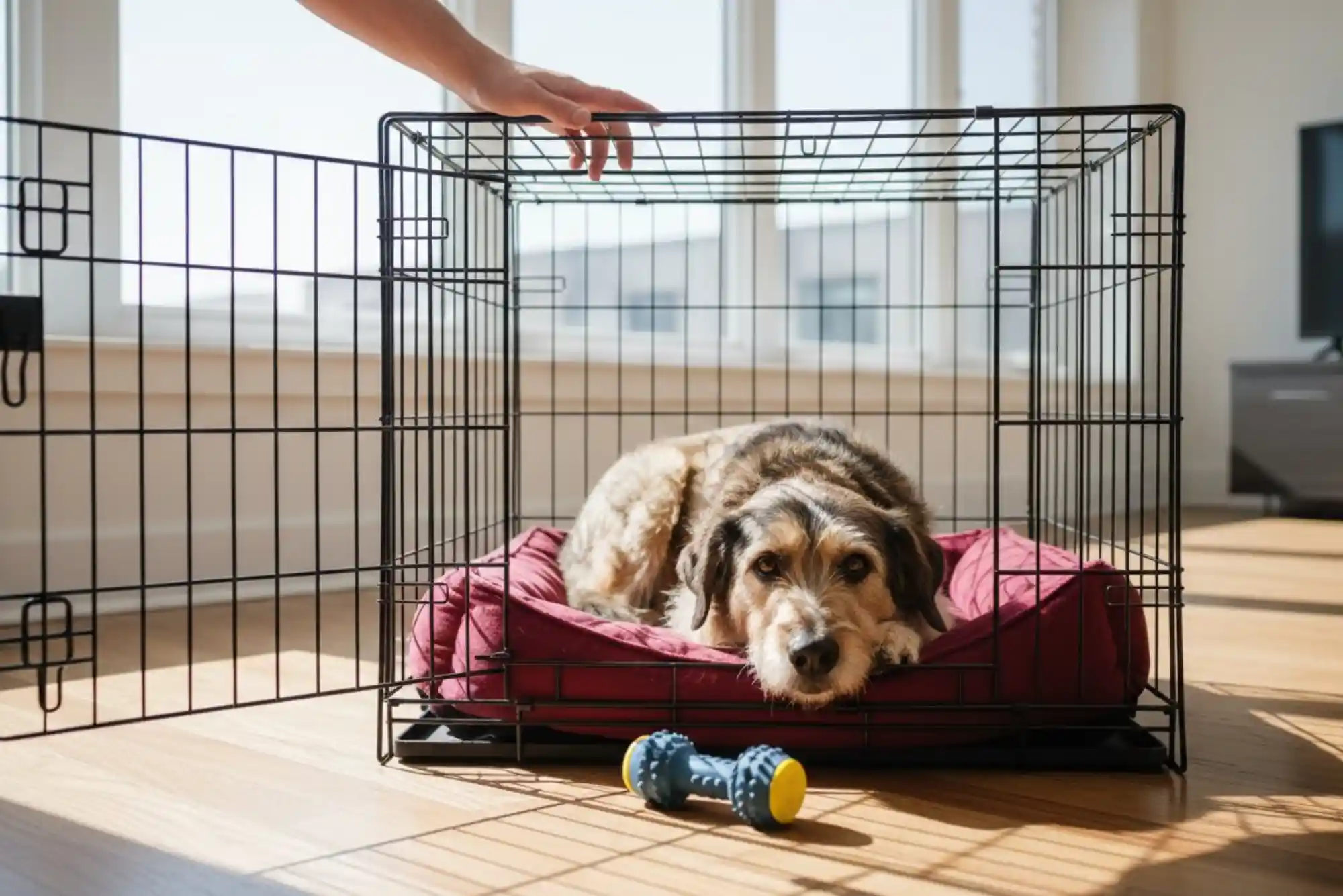
Introduction
Bringing an older rescue dog home can be incredibly rewarding, but it can also come with challenges that are not obvious at first. A dog may seem relaxed during the day yet panic when you leave the room. Another may tremble around a crate because confinement reminds them of a previous experience. Some older dogs also develop new fears because of changes in hearing, vision, pain, or cognitive function.
Learning how to crate train an older rescue dog requires a different mindset from training a confident puppy. The objective is not simply to close the door and increase the time inside. Instead, you want the dog to learn that the crate predicts safety, comfort, food, rest, and choice.
Most importantly, a crate is not a treatment for separation anxiety by itself. Some dogs find a crate comforting, while others become more distressed when confined. Heavy panting, drooling, frantic escape attempts, persistent vocalization, or attempts to injure themselves are signs that confinement may be increasing the problem rather than solving it.
With an older rescue, patience is not a minor part of the process. It is the process.
Why Crate Training an Older Rescue Dog Can Be Challenging
An older rescue dog arrives with a history you may not know. They may have lived in a home, kennel, shelter, or outdoor environment. They may have been confined appropriately, over-confined, or never introduced to a crate at all.
This history matters because dogs form associations with places and experiences. If a crate has previously been associated with isolation or punishment, simply putting treats inside may not immediately change the emotional response.


Age can also influence the process. Older dogs may have physical discomfort, reduced mobility, sensory changes, or medical conditions that make confinement harder. The ASPCA notes that anxiety and fear in older dogs can sometimes be related to medical problems, sensory decline, or cognitive dysfunction.
That is why crate training an older rescue dog should begin with understanding the individual dog rather than following a rigid timetable.
Before Crate Training, Rule Out Medical Problems
A sudden behavior change in an older dog deserves attention.
If a previously comfortable dog suddenly becomes restless, vocal, fearful, confused, or unable to settle, schedule a veterinary examination. Pain, urinary problems, sensory decline, and other age-related conditions can affect behavior. In senior dogs, nighttime anxiety and increased dependence can sometimes have a medical component.
Physical comfort matters inside the crate, too. Your dog should have enough room to stand, turn around, stretch, and lie down comfortably. Older dogs may also benefit from supportive bedding if their joints are sensitive.
The goal is to make the crate physically comfortable before asking the dog to tolerate emotional challenges.
Understand the Difference Between Separation Anxiety and Crate Anxiety
This distinction is essential when learning how to crate train an older rescue dog.
A dog with separation anxiety becomes distressed because their person is absent. A dog with confinement anxiety may become distressed specifically because they are behind a closed door, gate, or crate.
The two can occur together.
For example, your dog may happily sleep in an open crate while you are sitting nearby but panic as soon as you leave. That pattern suggests separation may be the primary trigger.
Another dog may become frantic immediately after the crate door closes, even though you remain in the room. In that case, confinement itself may be the bigger issue.
Watch what happens rather than assuming the diagnosis. A camera can be particularly useful during early alone-time training because it allows you to observe whether your dog remains relaxed after you leave.
Make the Crate a Choice, Not a Trap
The first stage of crate training an older rescue dog should involve almost no confinement.
Put the crate in an area where your dog normally feels comfortable. A family room can work well because the dog can investigate the crate while people are nearby. Veterinary behavior guidance also recommends allowing adult and older dogs to explore the crate freely before gradually introducing short periods behind the closed door.
Leave the door open.
Place comfortable bedding inside if your dog does not chew or destroy it. You can also offer meals, treats, or a safe food-stuffed toy inside the crate.
Do not push your dog inside.
Do not grab the collar and force them through the doorway.
Do not close the door the first time they enter.
Instead, let curiosity do some of the work. If your dog puts one paw inside, reward that. If they step completely inside, reward again. If they lie down, quietly reinforce that behavior.
The message should be simple: “Good things happen here, and you are safe.”
Build Positive Associations Gradually
Once your dog willingly enters the crate, begin rewarding calm behavior inside it.
You might offer a favorite chew while sitting nearby. When the dog finishes, allow them to leave. Repeat this until entering the crate appears ordinary rather than significant.
Next, briefly close the door while you remain beside the crate.
Start with an interval your dog can handle comfortably. That might be only a few seconds.
Then open the door while your dog is still relaxed.
Over multiple sessions, you can gradually increase the duration. VCA guidance similarly recommends progressing from an open crate to brief door closures, then gradually increasing time and distance.
The important word is gradually.
If your dog becomes frightened, the correct response is not to insist that they “get used to it.” Fear-based training can backfire when the dog is repeatedly exposed beyond their ability to cope. Desensitization works best when the intensity remains low enough for the animal to stay comfortable.
Teach Calmness Before Practicing Departures
A common mistake is going straight from “my dog can stay in the crate while I sit beside it” to “I am going to leave the house for an hour.”
That is a huge emotional jump.
Instead, teach your dog that you can move around without disappearing.
Sit beside the crate. Stand up. Sit down again.
Walk a few steps away and return.
Walk into another room for a moment and come back.
Gradually introduce distance while maintaining calm behavior.
This helps your dog learn that separation is temporary and predictable.
For a dog with genuine separation anxiety, the same principle applies to departures. ASPCA guidance recommends starting with extremely short absences and increasing them gradually while avoiding episodes that trigger full anxiety.
Use Food as a Relaxation Tool, Not a Bribe
Food can be extremely useful during crate training an older rescue dog, especially when the dog already enjoys eating.
Meals can be served inside the crate. A long-lasting, veterinarian-approved chew or food-stuffed toy can also help create a positive association.
However, food should not be used to trick a terrified dog into entering and then suddenly trap them.
If your dog eagerly takes food with the crate door open but refuses food as soon as the door closes, pay attention to that information. The dog may be telling you that the current step is too difficult.
VCA notes that refusing treats or becoming unable to settle can be a sign that desensitization is progressing too quickly.
Training should make the dog more confident, not merely make the owner more convenient.
Keep Phobias Separate From Crate Training
Older rescue dogs may have fears unrelated to separation. Thunderstorms, fireworks, traffic, unfamiliar people, slippery floors, certain rooms, or loud appliances can all become triggers.
Trying to solve every fear through the crate is unlikely to work.
Instead, identify each trigger and manage exposure carefully.
For example, if thunderstorms frighten your dog, the crate can potentially become a quiet retreat if the dog already feels safe there. Background sound, familiar bedding, and reduced exposure to frightening sights may help create a calmer environment.
But if your dog panics when thunder begins and then panics more intensely when placed inside the crate, the crate should not become mandatory confinement.
The ASPCA recommends addressing underlying medical issues and using behavior modification for fears and phobias rather than relying on punishment or forced exposure.
Know When the Crate Is Making Anxiety Worse
This is one of the most important parts of crate training an older rescue dog.
Some mild protest is different from genuine panic.
A dog who briefly whines and then settles may simply be adjusting. A dog who is panting heavily, drooling, frantically scratching, repeatedly throwing themselves against the door, trying to escape, or becoming increasingly distressed needs a different plan.
ASPCA specifically warns that crates can increase anxiety for some dogs with separation anxiety. VCA likewise notes that some dogs do better with a pen, gated room, or other confinement arrangement.
Never assume that more crying means the dog needs to “learn who is in charge.”
Fear is not stubbornness.
If the crate causes panic, stop and reassess.
Consider a Safe Room or Gated Area
A crate is only one form of management.
For an older rescue dog who dislikes confinement, a small dog-proofed room or gated section of the home may provide more freedom without sacrificing safety.
A comfortable bed, water, familiar smells, safe enrichment, and predictable surroundings can create a relaxation area without the physical restriction of a crate.
This can be especially useful when separation anxiety and confinement anxiety overlap. The objective is to reduce the dog’s overall stress while behavior modification addresses the underlying problem.
A successful training plan is not measured by whether the dog stays in a crate at all costs. It is measured by whether the dog becomes safer, calmer, and more capable of coping.
Create a Predictable Daily Routine
Predictability can be particularly valuable for rescue dogs who have experienced instability.
Try to keep meals, walks, rest, play, training, and bathroom opportunities reasonably consistent.
Give your dog opportunities to relax independently while you are still home. Encourage calm behavior on a mat or bed rather than allowing every interaction to revolve around following you.
This matters because a dog who cannot relax while you are home will usually struggle even more when you leave.
VCA behavior guidance recommends predictable routines and reinforcing calm, independent behavior as part of separation-anxiety treatment.
Practice Departures in Tiny Steps
Once your dog can calmly rest in the crate while you move around the house, you can begin practicing actual departures.
Do not start with a long trip.
Step outside briefly and return before your dog becomes anxious. Then repeat. Over time, gradually increase the duration according to your dog’s response.
There is no universal schedule because every rescue dog has a different threshold.
One dog might progress from seconds to minutes relatively quickly. Another may need weeks of careful work.
ASPCA emphasizes that separation-anxiety treatment requires gradual increases and that dogs should not repeatedly experience the full intensity of their fear during the training process.
If your dog panics at 30 seconds, practicing 60 seconds is not progress. Your starting point needs to be below the panic threshold.
Avoid Punishment and the “Cry It Out” Approach
Punishment is particularly risky with fearful rescue dogs.
Scolding barking, yelling when the dog scratches the crate, or forcing the dog inside can make the crate more frightening. The dog may begin associating you, the crate, and departures with unpleasant experiences.
Likewise, intentionally allowing severe panic to continue in the hope that the dog eventually gives up is not a reliable treatment for separation anxiety.
The aim of desensitization is to keep fear low enough that the dog can learn a new emotional response. When exposure becomes overwhelming, sensitization can occur instead.
Gentle does not mean permissive. It means structured, controlled, and based on the dog’s actual emotional response.
When to Work With a Veterinary Behaviorist
Professional help is appropriate when anxiety is severe, persistent, or dangerous.
If your dog is injuring themselves while attempting to escape, refusing food because of anxiety, showing extreme panic, or making no progress despite careful training, speak with your veterinarian.
A veterinary behaviorist or qualified behavior professional can help determine whether the problem is separation anxiety, confinement anxiety, a phobia, pain, cognitive change, or a combination of factors.
Medication may also be appropriate for some dogs as part of a broader treatment plan. Medication does not replace training, but reducing overwhelming anxiety can sometimes make behavior modification more achievable.
How Long Does Crate Training an Older Rescue Dog Take?
There is no reliable “seven-day” or “two-week” rule.
A confident adult dog with no negative crate history may become comfortable surprisingly quickly. A fearful rescue with previous confinement trauma may require considerably more time.
The right timeline is determined by behavior.
Your dog is ready to progress when they voluntarily enter the crate, remain relaxed with the door closed, accept food normally, settle comfortably, and recover quickly from small changes.
If anxiety appears, reduce the difficulty.
Think of progress as building trust rather than completing a checklist.
Make Safety the Goal
Learning how to crate train an older rescue dog is less about teaching a command and more about changing the dog’s emotional relationship with confinement and separation.
Start with veterinary care when needed. Introduce the crate without force. Build positive associations. Reward relaxation. Increase duration in tiny increments. Practice departures below the dog’s anxiety threshold, and always watch for signs that confinement is making the problem worse.
For some rescue dogs, a crate becomes a genuinely comforting retreat. For others, a gated room or safe area is the better choice. Either outcome can represent successful training.
FAQs
Can an older dog be crate trained?
Yes. Older dogs can learn to become comfortable with a crate. The process may take longer when a dog has a history of fear, neglect, unfamiliar confinement, or negative experiences. The key is to introduce the crate gradually and use positive reinforcement rather than forcing the dog inside.
How do you crate train an older dog?
Start by leaving the crate door open and allowing the dog to investigate it voluntarily. Reward calm behavior around and inside the crate, provide meals or appropriate enrichment there, and only introduce brief door closures after the dog is comfortable. Gradually increase duration while watching carefully for stress signals.
Can you crate train an older dog with separation anxiety?
It depends on the dog. A crate can be comforting for some dogs, but it can intensify panic in others. If the dog shows heavy panting, excessive drooling, frantic escape attempts, or persistent distress, the crate may not be appropriate for alone-time management. Separation anxiety generally requires a gradual behavior-modification program rather than crate training alone.
Is crate training good for dogs with separation anxiety?
Not automatically. A crate is useful only when the dog already considers it a safe place. If confinement increases anxiety, a gated room, pen, or other safe area may be better. The underlying separation anxiety still needs to be addressed through gradual desensitization and counterconditioning.
How long does it take to crate train an older rescue dog?
The timeline varies widely. Some dogs become comfortable within days or weeks, while fearful rescue dogs may need substantially longer. Progress should be based on the dog’s comfort rather than a fixed deadline. Rushing can create setbacks, particularly when fear or previous negative experiences are involved.
Should I let my older dog cry in the crate?
Brief vocalization does not necessarily mean panic, but escalating distress should not be ignored. If your dog becomes highly distressed, end the exercise and return to an easier training step. Continuing to expose a frightened dog to an overwhelming situation can worsen fear rather than teach relaxation.
What if my rescue dog is afraid of the crate?
Do not force the dog inside. Leave the crate open and begin building positive associations around it. Feed near the crate, reward voluntary investigation, and gradually encourage comfortable resting inside. If the dog has a strong fear response or a history of confinement trauma, professional behavior guidance can make the process safer and more effective.
Related Reading: How to Teach a Dog an Emergency Recall Command (Come When Called Every Time)