
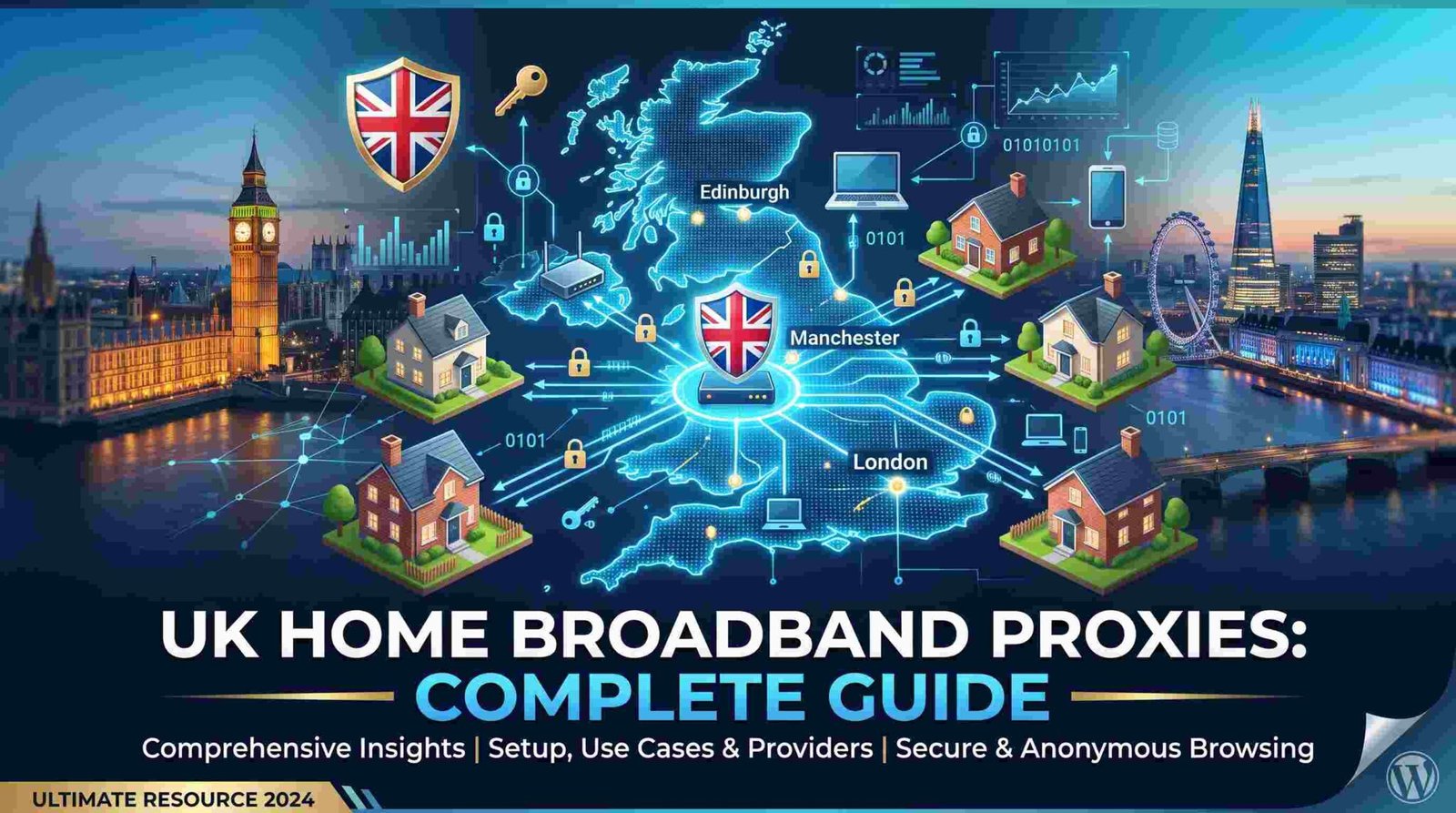
UK Home Broadband Proxies: How They Work and What to Look For
UK home broadband proxies are residential proxy connections that route internet traffic through IP addresses associated with household internet connections in the United Kingdom. They are useful for legitimate location-based research, SEO checks, advertising verification, e-commerce research and website testing.
The key is choosing a proxy that matches your location, performance, stability and rotation requirements.
What Are UK Home Broadband Proxies?
A UK home broadband proxy is associated with a residential internet connection rather than a traditional data-centre server. A proxy acts as an intermediary between your device or application and the website you access.
Instead of the destination website seeing your direct public IP address, the request is made through the proxy connection. Residential proxies are therefore useful when the residential nature of a UK connection is relevant to the task.
Typical legitimate uses include:
- UK search and SEO research
- Advertising verification
- E-commerce and price research
- Market research
- Location-based website testing
- Regional content verification
UK Residential Proxies vs Data-Centre Proxies
| Factor | UK Residential Proxy | Data-Centre Proxy |
|---|---|---|
| IP origin | Residential internet connection | Data-centre infrastructure |
| Best suited for | Residential-location research and verification | Server-based technical workloads |
| Connection model | Static or rotating | Static or rotating |
| Main advantage | Residential network perspective | Infrastructure and performance |
The right option depends on the task. A data-centre proxy may be enough when you simply need a UK IP, while a residential proxy is more appropriate when the connection type itself matters.


How UK Home Broadband Proxies Work
Your browser, software or application connects to a proxy endpoint. The proxy then connects to the destination website, so the destination sees the proxy IP rather than the public IP of your original connection.
UK residential proxies generally come in two main forms.
Static UK Residential Proxies
A static residential proxy keeps the same IP for the relevant session or service arrangement. This can be useful when consistency is important for testing or other legitimate workflows.
Rotating UK Residential Proxies
A rotating residential proxy changes the IP according to the provider’s rotation settings. This can be useful when legitimate research requires multiple residential endpoints or changing connections.
Rotation should not be treated as permission to bypass website restrictions or access controls.
Why Use UK Home Broadband Proxies?
SEO and Search Research
Search experiences can vary by location and other signals. A UK residential connection can help SEO teams examine websites and search experiences from a UK perspective.
The goal should be regional research and verification rather than attempting to manipulate search rankings.
Advertising Verification
Businesses can use UK residential connections to check whether advertisements, landing pages and campaigns appear correctly for users in the intended market.
E-Commerce Research
Online stores may present different content depending on location. A UK residential connection can help businesses research product availability, pricing and customer-facing experiences from the UK market.
Market Research
Companies entering the UK market can use residential connections to examine publicly available competitor information and location-specific website experiences.
Website Testing
Developers and QA teams can use UK residential connections to test location-sensitive website behaviour that may not appear from another country or network.
What to Consider When Choosing UK Home Broadband Proxies
1. UK Location Coverage
Check whether the provider offers country, regional or city-level targeting that matches your project. StableProxy’s UK residential service provides UK targeting options and references locations including London, Manchester and Birmingham.
2. Static or Rotating IPs
Choose static connections when continuity matters. Choose rotating connections when your legitimate workflow requires changing residential endpoints.
3. Speed and Latency
Proxy traffic adds another network layer, so performance matters. Test the service with your actual workflow instead of relying only on advertised performance claims.
4. Reliability
Look for clear information about uptime, connection stability, monitoring and technical support.
5. Authentication and Controls
Check how the service provides proxy credentials, location controls, rotation settings and account management features.
6. Pricing
Compare the actual package, traffic allocation, locations, rotation options and support rather than choosing solely by the lowest headline price. Current pricing should be checked directly with the provider.
Benefits and Limitations
Benefits
- UK-specific residential perspective
- Useful for regional research and verification
- Static and rotating options may be available
- Potential city or regional targeting
- Suitable for multiple professional research use cases
Limitations
- A residential IP does not guarantee complete anonymity.
- Performance can vary between connections.
- IP geolocation should not be treated as proof of a person’s exact physical location.
- A proxy does not grant permission to access restricted content or services.
- Privacy and data-protection obligations can still apply.
Common Mistakes to Avoid
Choosing Rotation When You Need Stability
Changing IP addresses can be counterproductive when your workflow requires a consistent connection.
Assuming Every UK IP Is the Same
Two UK IPs can differ in network, location, reputation and connection characteristics.
Choosing Only by Price
A low advertised price does not necessarily mean the service provides the locations, stability or controls your project needs.
Assuming a Proxy Removes Compliance Requirements
A proxy changes the network path used to access a website. It does not make otherwise unauthorised activity acceptable. UK rules concerning unauthorised computer access and data protection can still apply.
Assuming Residential Means No Blocking
No proxy type guarantees unrestricted access. Websites can use multiple signals and their own access policies when determining how requests are handled.
How to Choose the Right UK Home Broadband Proxy
Step 1: Define Your Objective
Identify whether you need SEO research, advertising verification, market research, e-commerce analysis or location-based testing.
Step 2: Decide Whether Residential IPs Are Necessary
If a normal UK data-centre IP provides everything you need, residential infrastructure may not be necessary. Use residential connections when the residential nature of the network is relevant.
Step 3: Select the Location
Determine whether you need UK-wide access, a specific region or a particular city.
Step 4: Choose Static or Rotating
Use static connections for continuity and rotating connections when changing residential endpoints is part of the legitimate research requirement.
Step 5: Test Performance
Evaluate response times, reliability, connection consistency and traffic requirements using your real workflow.
Step 6: Review Compliance
Make sure your intended activity is permitted and that any collection or processing of personal information complies with applicable requirements.
Who Uses UK Home Broadband Proxies?
SEO agencies can use them for UK search and visibility research.
Marketing teams can use them for advertising and campaign verification.
E-commerce businesses can use them for market research and price observation.
Researchers can use them to compare location-sensitive website experiences.
Developers and QA teams can use them for UK-specific website testing.
Brand protection teams can use them for monitoring and verification.
UK Home Broadband Proxies: Buying Checklist
| Requirement | What to Check |
|---|---|
| Location | UK, region or city availability |
| Proxy type | Residential |
| IP model | Static or rotating |
| Performance | Speed, latency and reliability |
| Controls | Location and rotation options |
| Authentication | Supported login and connection methods |
| Capacity | Traffic or allocation limits |
| Support | Documentation and technical assistance |
| Pricing | Current plans and total expected cost |
| Compliance | Acceptable-use requirements and applicable laws |
StableProxy’s UK residential service provides UK residential connections with location targeting and static and rotating options. Check the provider’s current page for the latest features and pricing.
Final Takeaway
UK home broadband proxies are useful when you need to access and evaluate websites from a UK residential-network perspective. They can support legitimate SEO research, advertising verification, e-commerce analysis, market research and location-based testing.
Before choosing a service, define your location requirements, decide whether residential IPs are necessary, choose between static and rotating connections, evaluate performance and confirm that your intended use follows the destination site’s rules and applicable UK requirements.
Frequently Asked Questions
What are UK home broadband proxies?
They are residential proxy connections associated with UK household internet networks, allowing traffic to reach websites through a UK residential IP instead of your direct public IP.
What is the difference between residential and data-centre proxies?
Residential proxies are associated with residential internet connections, while data-centre proxies use server infrastructure hosted in data centres.
Should I use a static or rotating UK residential proxy?
Use static proxies when connection continuity matters. Rotating proxies are useful when your legitimate research requires changing residential endpoints.
Can UK home broadband proxies be used for SEO research?
Yes. They can be used for legitimate regional SEO research and checking location-sensitive search and website experiences.
Do residential proxies guarantee anonymity?
No. A residential proxy can hide your direct public IP from the destination, but it does not guarantee complete anonymity or prevent all other forms of identification.
Are residential proxies legal in the UK?
Using a proxy is not automatically unlawful, but the legality depends on how the connection is used. Applicable rules concerning authorised access, privacy and data protection may still apply.
Related Reading: Intelligent Spending: How High-IQ Shoppers Are Using Coupons to Outsmart the System
Related Reading: Secure Your Home with the DESLOC C100 Smart Lock Deadbolt with LockVue Display Screen — full guide